
Gates and Gate Repair in Medford, Oregon
Gates that swing freely, latch every time, and stop dragging across the ground.
The gate is the hardest-working part of any fence. It gets opened and slammed a few thousand times a year, it carries its whole weight on one post, and it's usually the first thing to go wrong. A gate that drags, sticks, or won't latch is more than an annoyance. It means the dog gets out, the latch gets forced, and the hinges and post take even more strain every time someone yanks it shut. We fix and build gates all over the valley, from narrow side-yard gates on older lots in Ashland to wide driveway gates on the rural properties around Jacksonville. Most gate problems trace back to just a few causes, and nearly all of them are fixable without replacing the whole fence.
Below, we cover the signs your gate needs attention, why gates sag in the first place, how we repair or build one, and how to choose between a walk-through gate and a driveway gate. The section on sagging is worth a read even if your gate works fine today, since it explains what to watch for. If the rest of your fence is in rough shape too, our fence repair page covers posts, rails, and boards.
Signs Your Gate Needs Repair
The most common sign is a gate that drags. If the bottom corner on the latch side scrapes the ground or leaves a groove in the dirt, the gate has dropped.
A latch that won't line up is the same problem from a different angle. Most people solve it by lifting the gate to close it, which only speeds up the wear.
Look at the hinge post. If it leans toward the gate, even a little, the post is failing under the weight.
Check the hinges and screws. Loose screws, stripped holes, or bent hinges let the gate shift every time it swings.
And watch for a gate that swings open on its own. That usually means the hinge post is out of plumb, or the gate was hung slightly crooked from the start.
Why Gates Sag
A gate is basically a lever. All of its weight hangs off one side, pulling down on the latch end and pulling the top of the hinge post toward the opening. Over time, something gives.
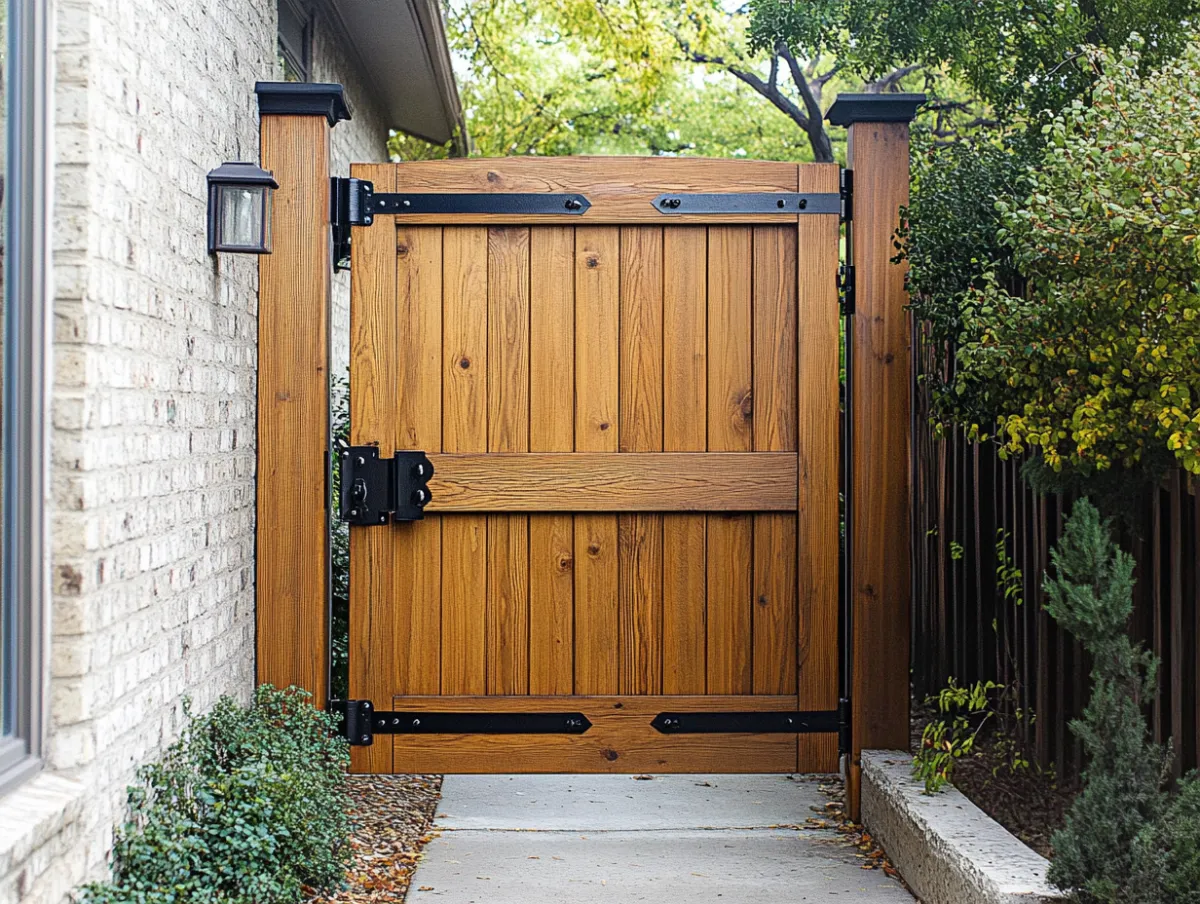
Most often, it's the post. A gate post needs to be bigger and set deeper than a regular fence post. We use at least a 4x6 or a 6x6 for wood gates, and a heavier post for wide or tall gates. A standard 4x4 set like the rest of the fence will lean eventually.
The gate frame matters too. A wood gate needs a diagonal brace running from the bottom corner on the hinge side up to the top corner on the latch side. Put the brace in backwards and it does almost nothing.
Hardware is the last piece. Heavy strap hinges and through-bolts hold up far longer than light hinges held on with short screws.
How We Repair and Build Gates
For a repair, we start by finding out what moved. If the post is leaning, we reset or replace it in concrete. If the frame has racked, we square it back up and add a proper brace or an anti-sag kit, a steel cable and turnbuckle that pulls the latch corner back up. If the hinges or screws are the issue, we swap in heavier hardware and through-bolt it.
For a new gate, we build or set the frame first, then add the boards or panels to match your fence. We hang it with even gaps on both sides, set the latch, and check that it swings and closes cleanly. Self-closing hinges are an easy upgrade if you have pets or a pool.
Most gate repairs take an hour or two. A new gate usually takes a day.
Walk-Through Gates vs. Driveway Gates
A walk-through gate is the standard single gate for a side yard or backyard, usually 3 to 4 feet wide. It needs to fit a person, a wheelbarrow, and maybe a mower. If you'll ever bring a riding mower or a garden cart through, go 5 feet.
A driveway gate is wider, often 10 to 16 feet, and is usually built as a double gate that opens from the middle. That keeps each half lighter and puts less strain on the posts. A drop rod on one side holds it in place when it's closed.
For very wide openings on rural properties, a single swing gate can work if it's built on heavy posts with solid bracing, and a wheel on the latch end can help carry the weight.
Whatever the size, the right post is what keeps it working.
For dog runs, back lots, and big openings on a budget, our chain link fencing page covers chain link gates, which are among the toughest and easiest to keep working.